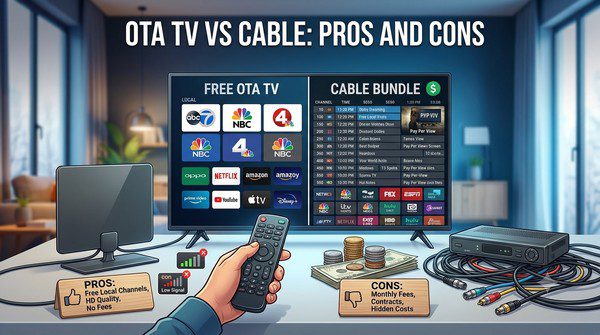
OTA TV vs Cable: Pros and Cons
If you’re thinking about cutting the cord, one of the first decisions you’ll face is whether to rely on Over-the-Air (OTA) TV or stick with traditional cable television. Both options let you watch live TV, but they work in very different ways and come with their own advantages and disadvantages.
OTA TV has been around for decades, long before cable became popular. Today, it has made a strong comeback as more people look for ways to reduce their monthly bills. With a simple TV antenna, many households can watch local channels completely free. Cable TV, on the other hand, continues to offer hundreds of channels, premium content, and bundled services, but usually comes with a much higher monthly cost.
This guide compares OTA TV and cable TV in detail. We’ll explain how each option works, their pros and cons, who they’re best suited for, and how to decide which one fits your viewing habits.
What Is OTA TV?
OTA stands for Over-the-Air television. Instead of receiving channels through a cable company or satellite dish, OTA broadcasts are transmitted from local TV towers and received using a television antenna.
If you live within range of broadcast towers, you can often receive popular local stations without paying any monthly subscription fees. Depending on your location, available channels may include local news, national networks, weather, educational programming, sports broadcasts, and entertainment shows.
Modern digital broadcasts usually provide much better picture quality than many people remember from the old analog television days.
What Is Cable TV?
Cable TV delivers television channels through underground or overhead cable lines connected directly to your home. After subscribing to a cable provider, you typically receive a cable box that allows you to access hundreds of television channels.
Most cable companies offer different packages, ranging from basic channel lineups to premium plans that include sports networks, movie channels, international programming, and on-demand content.
Many providers also bundle television with internet and home phone services.
How OTA TV Works
Using OTA TV is surprisingly simple. You connect an indoor or outdoor antenna to your television, perform a channel scan, and your TV searches for available broadcast stations in your area.
Unlike cable, there are no monthly bills once you’ve purchased your antenna.
The number of channels you receive depends on factors such as:
- Your distance from local broadcast towers
- The type of antenna you use
- Terrain and nearby buildings
- Weather conditions
Some homes receive only a handful of channels, while others may receive dozens.
How Cable TV Works
Cable television requires an active subscription with a cable provider. After installation, television signals are delivered through physical cables connected to your home.
Cable providers usually include:
- Live television channels
- Sports networks
- Movie channels
- Kids’ programming
- News channels
- Premium channel packages
- Video-on-demand libraries
Depending on the provider, DVR services and streaming apps may also be included.
Pros of OTA TV
No Monthly Bills
The biggest advantage of OTA television is that it’s free after purchasing an antenna. There are no subscriptions, contracts, or hidden fees.
Excellent Picture Quality
Many people are surprised to learn that OTA broadcasts can actually offer better picture quality than compressed cable signals. Local stations often broadcast in high definition with excellent image clarity.
Simple Setup
Most modern televisions include a built-in digital tuner. Connecting an antenna and scanning for channels usually takes only a few minutes.
Reliable During Internet Outages
Unlike streaming services, OTA television doesn’t depend on your internet connection. Even if your internet goes down, local channels continue working as long as the broadcast signal is available.
No Contracts
Since there are no monthly subscriptions, you never have to worry about cancellation fees or long-term commitments.
Cons of OTA TV
Limited Channel Selection
OTA television mainly provides local broadcast stations. Popular cable-only channels are generally not available.
Reception Depends on Location
Your viewing experience depends heavily on where you live. Homes located far from broadcast towers may receive fewer channels or weaker signals.
No Built-in DVR
Although external DVR devices are available, recording OTA television usually requires additional hardware.
Weather Can Affect Reception
Heavy rain, storms, or other environmental conditions may occasionally impact signal quality, especially for viewers using indoor antennas.
Pros of Cable TV
Large Channel Selection
Cable providers typically offer hundreds of channels covering almost every category imaginable, including sports, documentaries, movies, lifestyle, children’s programming, and international networks.
Premium Content
Many premium movie channels and exclusive sports packages are available through cable subscriptions.
Professional Installation
Most providers handle installation and equipment setup, making the process easy for customers.
Additional Services
Cable companies often bundle television with internet service, phone service, and even home security options.
Cons of Cable TV
Higher Monthly Cost
Traditional cable television is usually much more expensive than OTA TV. Monthly bills can increase further when equipment rental fees, taxes, and premium channels are added.
Long-Term Contracts
Some providers require contracts that make switching services more difficult.
Paying for Unused Channels
Many subscribers receive hundreds of channels but regularly watch only a small percentage of them.
Price Increases
Promotional pricing often expires after the first year, resulting in higher monthly bills.
OTA TV vs Cable: Side-by-Side Comparison
| Feature | OTA TV | Cable TV |
|---|---|---|
| Monthly Cost | Free after antenna purchase | Monthly subscription required |
| Number of Channels | Local broadcasts only | Hundreds of channels |
| Contracts | No | Sometimes required |
| Picture Quality | Excellent HD broadcasts | Generally very good |
| Sports | Limited to local broadcasts | Extensive coverage available |
| Premium Movies | No | Available |
| Internet Required | No | No |