HD vs 4K Streaming: Is It Worth It?
As streaming technology continues to improve, more movies, TV shows, and live events are becoming available in 4K Ultra HD. While many viewers are familiar with HD (High Definition), they may wonder whether upgrading to 4K streaming is worth the extra internet bandwidth or, in some cases, a higher subscription plan.
The answer depends on several factors, including your television, internet connection, viewing distance, and personal preferences. For some households, 4K offers a noticeably sharper and more immersive picture. For others, standard HD provides excellent quality without using as much data.
In this guide, we’ll compare HD and 4K streaming, explain the differences, and help you decide which option is best for your home.
What Is HD Streaming?
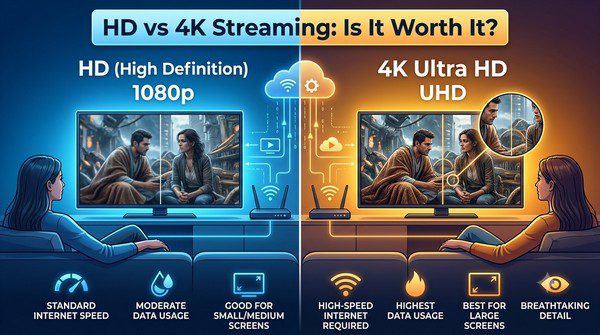
HD stands for High Definition. Most streaming services offer content in HD, usually with a resolution of 1920 × 1080 pixels, commonly called 1080p.
HD provides a sharp, clear picture that looks excellent on most televisions, laptops, tablets, and smartphones. For many viewers, Full HD remains more than enough for everyday streaming.
What Is 4K Streaming?
4K, also called Ultra HD (UHD), has a resolution of approximately 3840 × 2160 pixels. That means it contains four times as many pixels as Full HD.
The extra detail produces a sharper image, especially on larger television screens. Many 4K titles also support technologies such as HDR (High Dynamic Range), which can improve brightness, contrast, and color accuracy.
HD vs 4K at a Glance
| Feature | HD (1080p) | 4K (Ultra HD) |
|---|---|---|
| Resolution | 1920 × 1080 | 3840 × 2160 |
| Picture Detail | Very Good | Excellent |
| Internet Usage | Lower | Higher |
| Bandwidth Needed | Moderate | Fast connection recommended |
| Works on Older TVs | Yes | Requires a 4K TV for full benefit |
| Best Screen Size | Small to large | Medium to very large |
Picture Quality
The biggest difference between HD and 4K is image detail.
Because 4K has four times more pixels than HD, fine textures, facial details, landscapes, and small objects appear sharper and more realistic.
However, the improvement is easier to notice on larger televisions. On smaller screens, many viewers may find that HD already looks excellent.
Internet Speed Requirements
Streaming quality depends on both your subscription plan and your internet connection.
HD streaming generally requires less bandwidth and works well on most home internet connections.
4K streaming transfers much more data, so a stable, high-speed internet connection is recommended to avoid buffering or automatic quality reductions.
If multiple people are streaming at the same time, your home network may need additional bandwidth to support several 4K streams.
Data Usage
One important difference is how much internet data each format uses.
- HD streaming uses less data.
- 4K streaming uses significantly more data because of the higher video quality.
If your internet plan includes data limits, frequent 4K streaming may consume your monthly allowance more quickly than HD.
Do You Need a 4K TV?
Yes. To fully enjoy 4K streaming, you’ll need a television or monitor that supports 4K resolution.
If you watch 4K content on a Full HD television, the video will usually play in HD because the display cannot show the extra pixels.
You’ll also need a streaming device and streaming service that support 4K playback.
What About HDR?
Many people confuse 4K with HDR, but they are different technologies.
4K refers to the number of pixels on the screen.
HDR improves:
- Brightness.
- Contrast.
- Color accuracy.
- Shadow detail.
Many premium movies and TV shows support both 4K and HDR, creating a more realistic viewing experience on compatible equipment.
When Is HD the Better Choice?
HD may be the better option if you:
- Have slower internet speeds.
- Use a smaller television.
- Want to reduce data usage.
- Are satisfied with excellent picture quality.
- Watch primarily on smartphones or tablets.
For many viewers, Full HD delivers a clear and enjoyable picture without requiring extra bandwidth.
When Is 4K Worth It?
4K streaming is often worth considering if you:
- Own a large 4K television.
- Have fast and reliable internet.
- Enjoy movies with high-quality visuals.
- Watch nature documentaries or action films.
- Want the best available picture quality.
Many modern streaming platforms now offer growing libraries of 4K content, making the upgrade more appealing than ever.
Can Streaming Services Automatically Change Quality?
Yes.
Most streaming services automatically adjust video quality based on your internet speed.
If your connection becomes slower, the service may temporarily reduce playback from 4K to HD or even lower resolutions to prevent buffering.
Common Myths About HD and 4K
Myth: Everyone Can Easily See the Difference
False. The improvement depends on your screen size, viewing distance, eyesight, and the quality of the original content.
Myth: 4K Always Looks Better
Not always. Poorly produced content won’t necessarily look dramatically better simply because it is streamed in 4K.
Myth: You Need 4K for Good Streaming
False. Full HD still provides excellent picture quality and remains the most common streaming resolution for many households.
Frequently Asked Questions
Is 4K worth paying extra for?
If you have a compatible TV, fast internet, and enjoy premium picture quality, many viewers find the upgrade worthwhile.
Can I watch 4K on an HD TV?
The content will usually play, but it will be displayed in HD because the television cannot show the additional pixels.
Does 4K require faster internet?
Yes. Because it transfers much more video data than HD, a faster and more stable internet connection is recommended.
Does 4K use more internet data?
Yes. Streaming in 4K typically consumes considerably more data than streaming in HD.
Which is better for everyday streaming?
For many households, HD offers an excellent balance between picture quality, internet usage, and compatibility. Viewers with larger 4K TVs and reliable high-speed internet may benefit more from streaming in Ultra HD.
Choosing between HD and 4K streaming comes down to your equipment, internet connection, and viewing preferences. HD continues to deliver impressive picture quality and remains the ideal choice for many people, especially those with smaller screens or limited bandwidth.
If you own a modern 4K television and have a fast internet connection, 4K streaming can provide a sharper, more detailed, and more immersive viewing experience. The best option is the one that matches your setup and allows you to enjoy your favorite movies and TV shows without unnecessary buffering or extra costs.